Culvert Element
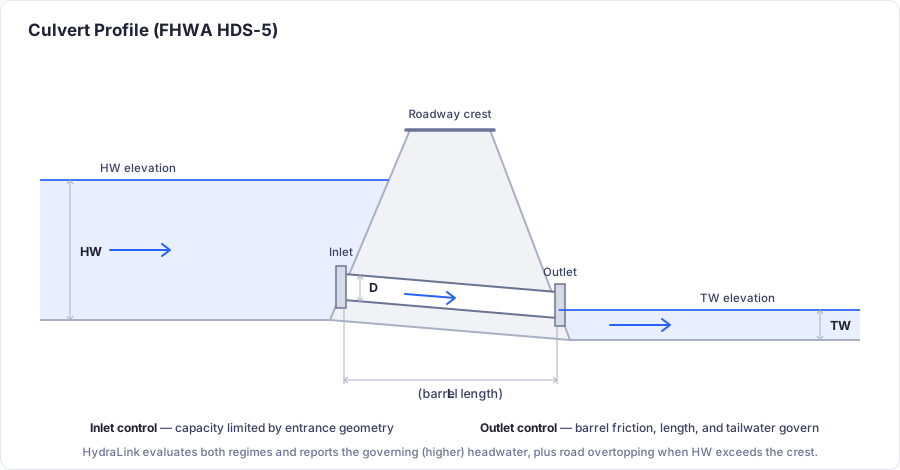
The Culvert element analyzes the hydraulic capacity of culvert crossings using the FHWA HDS-5 (Hydraulic Design of Highway Culverts) methodology. It evaluates both inlet control and outlet control conditions and reports the governing headwater elevation, capacity, and road overtopping flow.
When to Use
- Evaluating existing or proposed culvert crossings
- Sizing culverts for roadway crossings
- Determining headwater elevation and adequacy for design storms
- Analyzing road overtopping conditions
Barrel Shapes
Two barrel shapes are supported:
- Circular: Defined by diameter (D). Area = π/4 × D². Hydraulic radius R = D/4 (flowing full).
- Box (Rectangular): Defined by width (W) and height (H). Area = W × H. Hydraulic radius R = (W×H) / (2×(W+H)).
Entrance Types
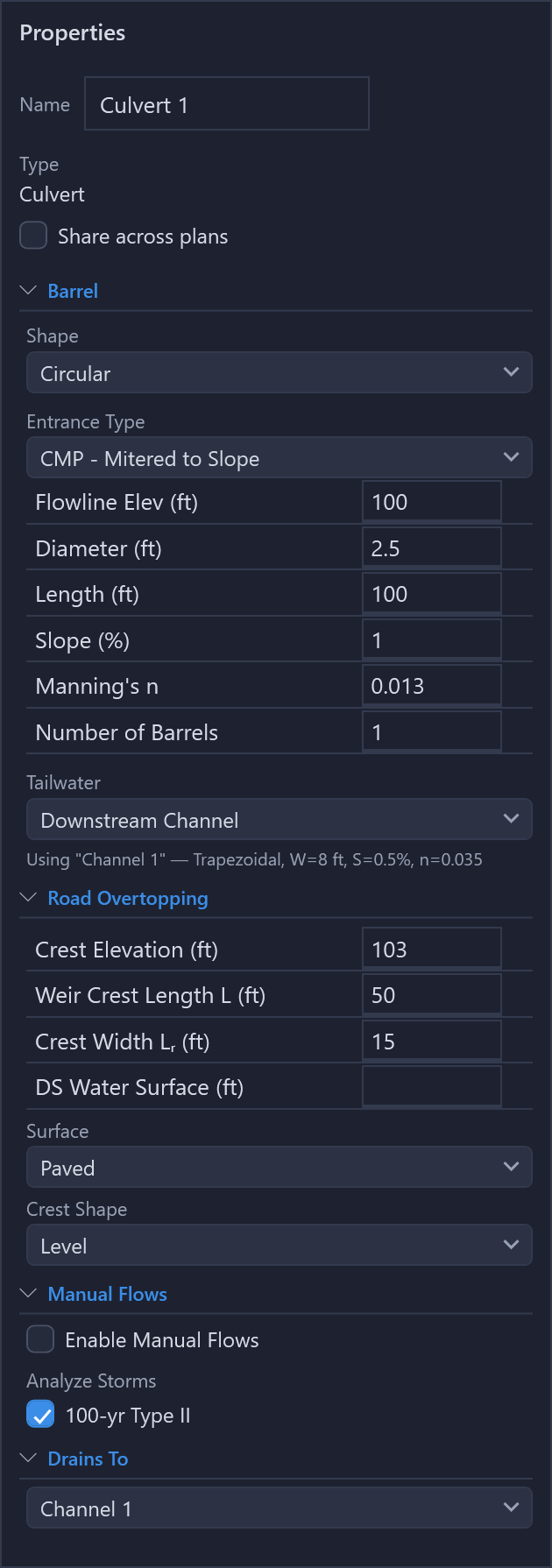
HydraLink includes 15 entrance configurations. Each entrance type has its own inlet control curve and an entrance loss coefficient Ke (HDS-5 Table C.2) for outlet control.
Circular Culverts
| Entrance Type | Ke | Description |
|---|---|---|
| Concrete - Square Edge w/ Headwall | 0.50 | Standard headwall with square-edged entrance |
| Concrete - Groove End w/ Headwall | 0.20 | Grooved (bell) end set in a headwall |
| Concrete - Groove End Projecting | 0.20 | Grooved (bell) end projecting from fill |
| Concrete - Beveled Edge (1:1) | 0.20 | Entrance with 45° beveled edges |
| Concrete - Beveled Edge (1.5:1) | 0.20 | Entrance with 33.7° beveled edges |
| Concrete - Mitered to Slope | 0.70 | Concrete pipe cut to match embankment slope |
| CMP - Headwall | 0.50 | Corrugated metal pipe with headwall |
| CMP - Thin Wall Projecting | 0.90 | Thin-wall pipe projecting from embankment |
| CMP - Mitered to Slope | 0.70 | Metal pipe cut to match embankment slope |
Box Culverts
| Entrance Type | Ke | Description |
|---|---|---|
| Box - Square Edge | 0.50 | Square-edged box with 90° headwall |
| Box - Beveled Edge (1.5:1) | 0.20 | Box with 33.7° beveled entrance edges |
| Box - Beveled Edge (1:1) | 0.20 | Box with 45° beveled entrance edges |
| Box - Wingwall 30-75 | 0.40 | Box with wingwalls flared 30° to 75° |
| Box - Wingwall 90/15 | 0.50 | Box with wingwalls at 90° or flared 15°, square-edged crown |
| Box - Wingwall 0 (Side Ext.) | 0.70 | Box with parallel wingwalls (extension of sides) |
Inlet vs. Outlet Control
Both inlet control and outlet control headwater depths are computed independently; the higher value governs. This follows the HDS-5 dual-analysis approach used by FHWA HY-8.
Inlet Control (HY-8 Polynomial Method)
Inlet control headwater is computed using the FHWA HY-8 fifth-order polynomial equations rather than the traditional HDS-5 K/M two-equation approach. This provides a single continuous curve that smoothly transitions between unsubmerged and submerged conditions without requiring regime interpolation.
Flow parameter:
Headwater depth:
Where:
- poly(X) = the HY-8 inlet control polynomial for the selected entrance type
- SR = the entrance type’s slope correction factor
- S0 = barrel slope (ft/ft)
- D = barrel rise (diameter for circular, height for box)
Results remain valid from lightly loaded through deeply submerged inlets.
Outlet Control (Backwater Analysis)
Outlet control computes the water surface profile through the barrel from the tailwater, the barrel slope and roughness, and the entrance loss Ke, rather than relying on the simplified single-equation HDS-5 energy method alone. It covers mild and steep barrels, partly full and full barrels, and a hydraulic jump inside the barrel. Inlet and outlet control follow HDS-5, and results are checked against FHWA HY-8 v7.7 (see HY-8 Comparison below).
Tailwater at the Outlet
The tailwater condition describes the receiving water at the outlet. Free outfall is tailwater depth 0. Specified elevation is a stage you enter. Downstream channel solves normal depth in the connected channel at each storm's own flow, so it varies with discharge without being stated per storm. Crown takes the tailwater at the top of the barrel, which is the outlet invert plus the rise (the diameter of a pipe, the height of a box). The outlet is submerged exactly, so the barrel is analyzed flowing full. Because it is barrel geometry rather than a stage, there is nothing to enter and it follows the barrel if you resize or move it; use it when the stage below the crossing is not known and you want a conservative starting point, or when the outlet is known to run submerged.
Barrel Profile in the Results
The Culvert Results dialog draws the water surface profile through the barrel. The outlet depth reported in the results is read from the downstream end of that profile, so the table, the outlet velocity and the profile agree.
Critical Depth
Circular: solved iteratively from the critical-flow condition using the exact partial-circle geometry:
Box:
Road Overtopping
When headwater exceeds the road crest elevation, road overtopping flow is computed using FHWA HDS-5's Figure 3.11 discharge-coefficient charts. The discharge coefficient is read from the head over the crest, the crest width, and the road surface type, with a submergence reduction applied when the downstream water surface rises over the crest.
| Parameter | Units | Description |
|---|---|---|
| Crest Elevation | ft | Elevation of the road surface at the crossing |
| Weir Crest Length L | ft | Length of road crest along the crossing (weir length) |
| Crest Width Lr | ft | Width of the roadway in the flow direction |
| DS Water Surface | ft | Optional downstream water surface elevation, used for submergence reduction |
| Surface | — | Paved or Gravel. HDS-5 publishes separate coefficient curves for each |
| Crest Shape | — | Level, or Sag Vertical Curve when the road dips over the crossing |
Total flow = culvert flow + overtopping flow (when headwater > crest elevation).
A weir crest length or crest width of 0 on a configured road disables the overtopping analysis. Always verify that the crest elevation, weir crest length, and crest width are set correctly, since overtopping flow can be a significant portion of total flow during extreme events.
Manual Flow Mode
The culvert can accept manual flow inputs instead of computing from an upstream hydrograph:
- Enable “Enable Manual Flows”
- Enter up to 2 manual flows with custom labels (e.g., “25-yr Pre-Dev”, “100-yr Post-Dev”)
In hydrograph mode, the Analyze Storms checklist picks which storms the culvert is evaluated for; it is disabled while manual flows are on.
Manual flow mode is useful for evaluating culvert capacity without building a full upstream network. This allows quick analysis of specific design flows.
Results
HydraLink flags an HW/D ratio above 1.5 and any headwater over the road crest in the results verdict; tighter local limits are the engineer's call.
The Culvert Results dialog presents the same run as a profile, a rating curve, and a summary table.
Tips & Best Practices
- HW/D ≤ 1.0 is generally considered adequate for most jurisdictions.
- Some jurisdictions allow HW/D up to 1.2 or 1.5; check local standards.
- If headwater exceeds the road crest, the culvert is overtopping. Evaluate whether this is acceptable for the design storm.
- Use a lower Manning's n for concrete (0.012–0.013) and higher for corrugated metal (0.024–0.027).
- Multiple barrels are modeled as parallel identical barrels sharing the total flow equally.
- Always verify that the road overtopping parameters are set correctly, since overtopping flow can be a significant portion of total flow during extreme events.
- The entrance type significantly affects inlet control capacity: beveled and groove-end entrances provide substantially better performance than square-edge.
HY-8 Comparison
HydraLink's culvert engine has been compared against FHWA HY-8 v7.7 across a range of flow conditions, barrel sizes, entrance types, and slope regimes. The following summarizes the key alignments.
Methodology Alignment
| Feature | HY-8 Approach | HydraLink Implementation |
|---|---|---|
| Inlet control | Fifth-order polynomial per entrance type | Fifth-order polynomials calibrated to HY-8 v7.7 program output |
| Outlet control | Direct-step backwater with crown transition | Direct-step backwater with crown transition detection |
| Slope classification | Compare yn to dc | Same (steep when yn < dc) |
| Steep slope outlet control | S2/S1 profiles with hydraulic jump detection | Same dual-profile approach with sequent depth check |
| Maximum slope | 55% (0.55 ft/ft) | 55% enforced by validation |
References
- FHWA (2012). Hydraulic Design of Highway Culverts, HDS-5, Third Edition.
- FHWA. HY-8: Culvert Hydraulic Analysis Program, v7.7. Federal Highway Administration.