Reach Routing Methods
Overview
Reach routing simulates the movement of a flood wave through a channel or conduit. As a hydrograph travels through a reach, two effects occur: translation (the hydrograph is delayed) and attenuation (the peak is reduced and the hydrograph is spread out). Different routing methods model these effects with varying levels of detail.
Method Comparison
| Method | Translation | Attenuation | Parameters | Physical Basis |
|---|---|---|---|---|
| Lag | Yes | No | Lag time | None |
| Muskingum-Cunge | Yes | Yes | Channel geometry | Physics-based |
| Modified Puls | Yes | Yes | Storage-discharge table | Empirical |
| Kinematic Wave | Yes | None (numerical only) | Channel geometry | Physics-based |
Lag Method
The simplest routing approach. It shifts the inflow hydrograph forward in time by a fixed lag time, and no attenuation occurs: the outflow hydrograph has the same shape and peak as the inflow, only translated (shifted) in time.
Regional Consideration: Lag routing does not attenuate the flow; it only translates the hydrograph in time. This is typically used for relatively short reaches where the travel time is small relative to the hydrograph duration and where channel storage effects are negligible. For longer reaches or reaches where storage effects are significant, a routing method that provides attenuation (such as Muskingum-Cunge or Modified Puls) may be more appropriate. The engineer should evaluate whether lag routing adequately represents the physical system for the given application, considering local design criteria and site conditions.
Muskingum-Cunge Method
Derives Muskingum K and X parameters from physical channel properties, eliminating the need for calibration. This method is widely used for open channel routing when channel geometry is known. HydraLink uses the variable-parameter Muskingum-Cunge method described in the HEC-HMS Technical Reference Manual: K and X follow the flow actually being routed rather than being fixed once for the reach.
Inputs and Equations
The method works from the reach length, slope, Manning’s n, and cross-section (trapezoidal, rectangular, triangular, circular pipe, or an eight-point station–elevation section). The routing parameters are the standard Cunge expressions:
where c = kinematic wave celerity (dQ/dA), T = top width, and S = channel slope.
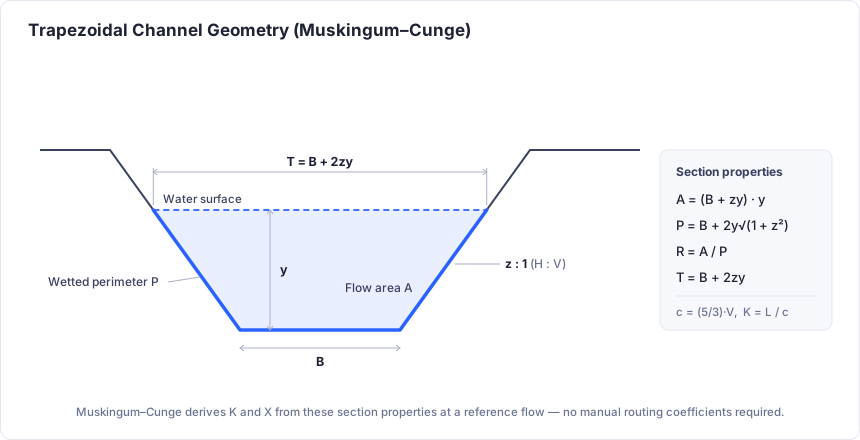
Not appropriate for: backwater-affected reaches, very flat slopes (S < 0.0001), tidally influenced areas, reaches with significant floodplain storage, or supercritical flow conditions. In these cases, use Modified Puls with a storage-discharge relationship from hydraulic modeling. HydraLink also warns when the flow exceeds the section’s capacity (those time steps pass through without attenuation, so enlarge the section or check the inflow) and when the reach length and time step are poorly matched for the flow.
Modified Puls (Storage-Indication) Method
Uses a known storage-discharge relationship to route the hydrograph.
Storage Indication Curve
Routing
At each time step, interpolate O from the SI curve. This method is suitable for reaches where the storage-discharge relationship is known from field data or detailed hydraulic modeling. The table is entered as storage in acre-feet against discharge in cfs, and the reach can be split into subreaches.
Kinematic Wave Method
Assumes the momentum equation reduces to a balance between friction and gravity (kinematic approximation). Uses the same channel geometry as Muskingum-Cunge.
Best for steep, friction-dominated channels. HydraLink warns when the slope is too flat for the method, where any apparent attenuation is numerical rather than physical; consider Muskingum-Cunge there. It also warns when the time step is poorly matched to the reach length. Not suitable for backwater effects.
Selecting a Routing Method
The appropriate routing method depends on the site conditions, available data, and local design criteria. The following considerations may help guide the selection:
- Lag is appropriate for relatively short reaches where attenuation is negligible. It provides translation only (no peak reduction). The engineer should consider whether neglecting attenuation is appropriate for the given reach length and conditions.
- Muskingum-Cunge is commonly used when channel geometry is known but calibration data is unavailable. It derives routing parameters from measurable channel properties.
- Modified Puls works well when the storage-discharge relationship is known from field data or detailed hydraulic modeling (e.g., wide floodplain sections).
- Kinematic Wave suits steep channels where inertial and pressure gradient terms are small.
The selection of a routing method is an engineering judgment decision. Local design criteria, jurisdictional requirements, and the physical characteristics of the reach should all be considered when selecting a method.
References
- Cunge, J.A. (1969). “On the Subject of a Flood Propagation Computation Method.” Journal of Hydraulic Research.
- USACE (2000). HEC-HMS Technical Reference Manual.
- Chow, V.T. (1959). Open-Channel Hydraulics. McGraw-Hill.