Reach Element
Overview
The Reach element represents a channel or conduit that conveys and routes flow from upstream to downstream. Reaches model the translation (delay) and attenuation (peak reduction) of hydrographs as they travel through the drainage system. HydraLink supports four routing methods, each suited to different situations.
When to Use
- Between any two elements where flow is conveyed through a channel, pipe, or overland flow path
- When hydrograph attenuation and translation through a channel segment is important
- For modeling the effect of channel geometry on hydrograph shape
Routing Method Comparison
| Method | Complexity | Attenuation | Best For | Requires |
|---|---|---|---|---|
| Lag | Low | None | Short reaches, quick estimates, preliminary analysis | Lag time only |
| Muskingum-Cunge | Medium | Yes | Open channels where geometry is known and calibration data is unavailable | Channel geometry (length, slope, Manning's n, cross-section) |
| Modified Puls | Medium | Yes | Reaches where storage-discharge relationship is known | Storage-discharge table |
| Kinematic Wave | Medium | Yes | Steep channels where other methods may be unstable | Channel geometry |
Input Parameters
Every reach shows its upstream element(s), read-only, and a Drains To selector for the downstream element. New reaches default to the Lag method.
Lag Method
| Parameter | Units | Description | Notes |
|---|---|---|---|
| Lag Time | minutes | Time delay applied to the hydrograph | Hydrograph shape is preserved unchanged; only shifted in time |
Muskingum-Cunge Method
| Parameter | Units | Description | Notes |
|---|---|---|---|
| Length | ft | Reach length | Measured along the channel centerline |
| Slope | ft/ft | Channel bed slope | Positive value, typically 0.001–0.05 |
| Manning's n | dimensionless | Roughness coefficient | See standard tables; typical 0.03–0.05 for natural channels |
| Cross-Section | — | Trapezoidal, Rectangular, Triangular, Circular, or Eight-Point | Circular asks for a diameter; Eight-Point is entered as station–elevation pairs via Edit Section… |
| Bottom Width | ft | Width of channel bottom | Applies to the shape chosen |
| Side Slope | H:V | Horizontal to vertical side slope ratio | e.g., 3 means 3 ft horizontal per 1 ft vertical |
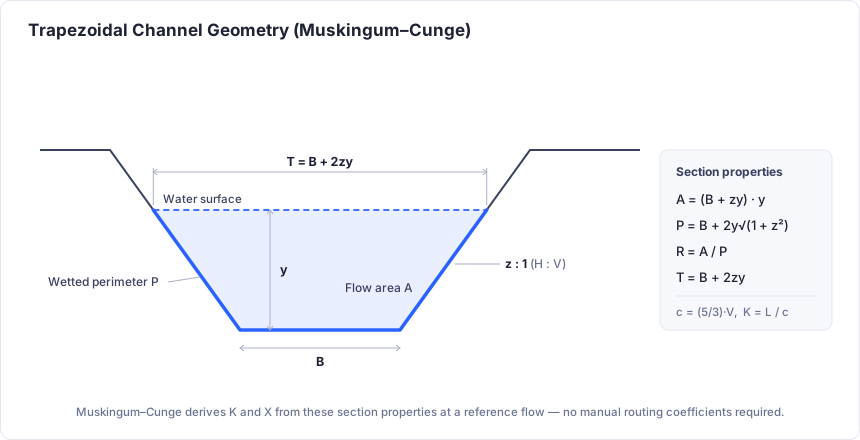
How it works: HydraLink uses the variable-parameter Muskingum-Cunge method described in the HEC-HMS Technical Reference Manual, deriving K = Δx / c and X = 0.5 × (1 − Q / (T × c × S × Δx)) from the channel geometry, slope and roughness as the flow changes. The run log warns when the flow exceeds the section’s capacity or when the reach length and time step are poorly matched. See Reach Routing.
Modified Puls Method
| Parameter | Units | Description | Notes |
|---|---|---|---|
| Subreaches | — | Number of subreaches | Divides storage-discharge among subreaches |
| Storage-Discharge Table | acre-ft vs cfs | Paired storage and discharge values | Defines the relationship between reach storage and outflow |
The Modified Puls method uses the storage-indication approach: (2S/Δt + O) is plotted against O. For each time step:
SIj+1 = Ij + Ij+1 + SIj − 2Oj
Outflow is interpolated from the SI curve.
Kinematic Wave Method
| Parameter | Units | Description | Notes |
|---|---|---|---|
| Length | ft | Reach length | Same geometry inputs as Muskingum-Cunge |
| Slope | ft/ft | Channel bed slope | Works best for steep slopes |
| Manning's n | dimensionless | Roughness coefficient | |
| Cross-Section | — | Trapezoidal, Rectangular, Triangular, Circular, or Eight-Point | Same shape choices as Muskingum-Cunge |
| Bottom Width | ft | Channel bottom width | Applies to the shape chosen |
| Side Slope | H:V | Side slope ratio |
Results
| Output | Units | Description |
|---|---|---|
| Peak Inflow | cfs | Maximum inflow to the reach |
| Peak Outflow | cfs | Maximum routed outflow |
| Volume In / Volume Out | acre-ft | Inflow and routed outflow volumes; the difference is the attenuation stored in the reach |
| Peak Time | h:mm | Time of peak outflow |
| Routed Hydrograph | cfs vs. time | Full outflow hydrograph |
Tips & Best Practices
- Muskingum-Cunge is commonly used when channel geometry is known and calibration data is unavailable. The appropriate routing method depends on site conditions and local design criteria.
- Modified Puls is often used when you have survey data defining the storage-discharge relationship of a reach (e.g., a wide floodplain section).
- Reach length should be measured along the channel thalweg, not as a straight-line distance.