Pond Routing
Overview
Pond routing determines how an inflow hydrograph is attenuated as it passes through a detention or retention facility. HydraLink uses the Modified Puls (level pool) routing method for ponds, combined with a stage-storage-discharge relationship defined by the pond geometry and outlet structures.
Modified Puls Method
Theory
The Modified Puls method assumes level pool conditions: the water surface in the pond is horizontal at all times. This is valid for ponds where the inflow rate is small compared to the pond surface area.
Routing Procedure
- Compute the stage-storage-discharge table by evaluating all outlet structures at each elevation in the storage table
- Compute the storage-indication curve:
SI = 2S/Δt + Oat each stage - For each time step:
SIj+1 = Ij + Ij+1 + (SIj − 2Oj)- Interpolate Oj+1 from the SI vs O relationship
- Compute stage and storage from the stage-storage-discharge table
- Track peak stage, peak outflow, and timing
On a pond with a Normal WSEL, the stage-storage-discharge table starts at the pool with zero storage and routing starts there, so peak storage is the volume used above the pool. If the routed water surface rises above the top of the storage table, the run fails with Pond overtopped and the storm’s peak stage. Add contours up to the real top of the berm, enlarge the pond, or release more, then run again.
When the pond takes its tailwater from a downstream element, the downstream water surface submerges this pond's outlets as the run proceeds and reduces their release.
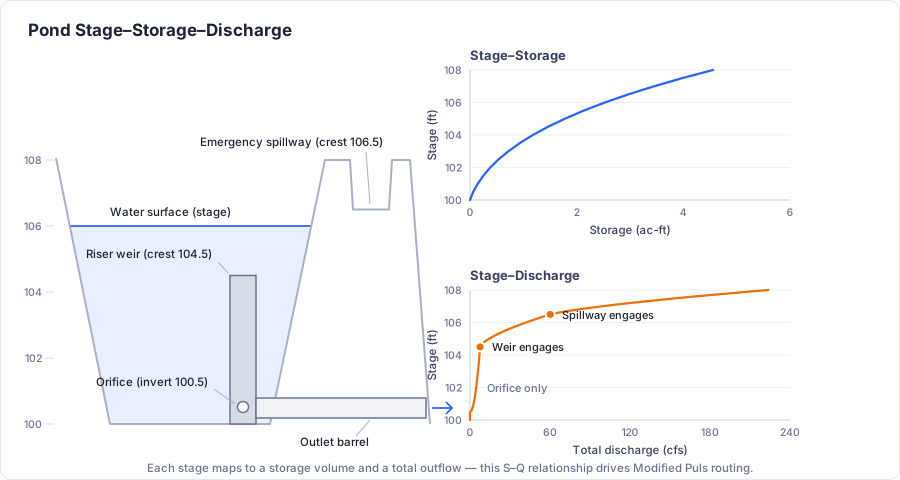
Stage-Storage-Discharge Computation
At each elevation in the storage table:
- Storage S = cumulative volume from the lowest elevation
- Discharge O is assembled as:
- Primary outlet = the riser (its orifices, weirs, and top overflow)
draining through the primary culvert, so the culvert limits what the riser can
release. Riser openings use
Q = Cd × A × √(2gh)for orifices andQ = Cw × L × H3/2for weirs, with H = stage − crest elevation - each weir of the weir structure either drains through the primary culvert with the riser, limited by the culvert in the same way, or, when set to spill freely (an emergency spillway, for one), adds to the total on its own
- plus secondary culvert flow (HDS-5 analysis)
- Exfiltration leaves the storage balance but is not routed downstream
- Primary outlet = the riser (its orifices, weirs, and top overflow)
draining through the primary culvert, so the culvert limits what the riser can
release. Riser openings use
MRM Detention Sizing
For basins using the Modified Rational Method, the pond can perform a simplified detention sizing analysis without requiring a full stage-storage-discharge relationship.
See the Modified Rational Method methodology page for details.
Outlet Structure Hydraulics
Culvert (Primary and Secondary)
Full HDS-5 analysis. See the Culvert element page.
Riser Structure
The riser acts as a vertical pipe or box with multiple openings at different elevations.
Orifice Equations
- Circular:
A = π/4 × D²,Q = Cd × A × √(2gh), default Cd = 0.6 - Rectangular:
A = W × H, same discharge equation
Weir Equations
A wall weir is a notch cut to the riser top, so the weir law holds at every head. Its width at the top is taken out of the rim’s weir length.
Top Overflow
When water overtops the riser, the rim acts as a weir. At higher heads the riser throat limits the flow instead.
Weir Types
The same four types serve every weir of the weir structure, the spillway included. Which one describes which physical structure is set out under Choosing a Weir Type.
| Type | Equation | Notes |
|---|---|---|
| Sharp-Crested | Q = Cw × (L − 0.1 × N × H) × H3/2 | Francis formula; N = 0, 1, or 2 end contractions |
| Broad-Crested | Q = Cw × L × H3/2 | Cw as entered (3.00 default) |
| V-Notch | Q = Cw × (8/15) × √(2g) × tan(θ/2) × H5/2 | Notch angle θ entered (90° default); Cw defaults to 0.58 |
| Cipolletti | Q = Cw × L × H3/2 | Trapezoidal weir; Cw as entered (3.367 default) |
Design Considerations
- The primary outlet (culvert or riser orifices) controls outflow for frequent storms
- Weirs activate at higher stages for larger storms
- The spillway weir should be sized to pass extreme events without overtopping the embankment
- Outlets that discharge independently (the secondary culvert, a weir set to spill freely) add together; a riser or weirs draining through the primary culvert are limited by what that culvert can pass
References
- NRCS (2010). National Engineering Handbook, Part 630, Chapter 17, Flood Routing.
- FHWA (2001). Urban Drainage Design Manual, HEC-22.
- Akan, A.O. (1993). Urban Stormwater Hydrology. Technomic Publishing.