Time of Concentration (TR-55)
Overview
Time of concentration (Tc) is the time required for runoff to travel from the hydraulically most remote point of a drainage area to the outlet. It is a critical parameter in both the Rational Method (determines rainfall intensity) and the Unit Hydrograph method (determines lag time and hydrograph timing).
HydraLink computes Tc using the NRCS TR-55 method, which divides the flow path into up to three segment types: sheet flow, shallow concentrated flow, and channel flow.
On the basin panel, choose TR-55 Method and click Edit Flow Path… to open the TR-55 Time of Concentration dialog. It holds one grid per segment type; add as many rows as the flow path needs and the subtotals and total Tc update as you type.
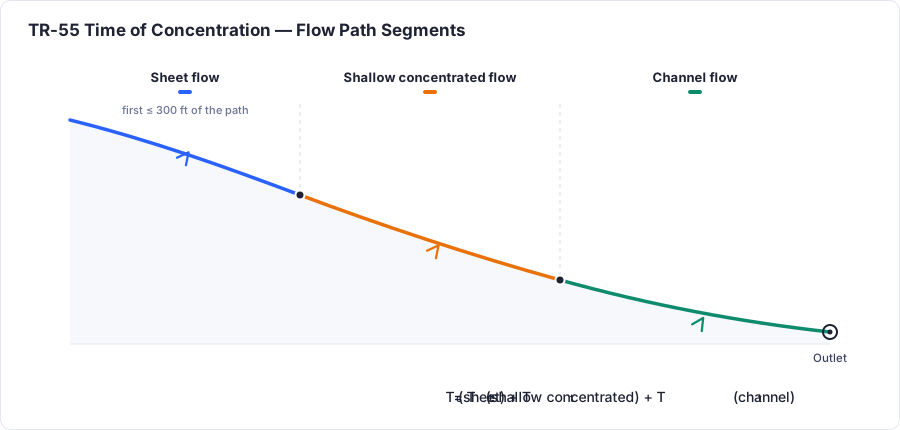
Sheet Flow
The uppermost segment of the flow path, where runoff flows as a thin sheet over the land surface.
Where:
- Tt = travel time (hours)
- n = Manning's roughness coefficient for sheet flow (NOT channel Manning's n)
- L = flow length (ft), maximum 300 ft
- P2 = 2-year, 24-hour rainfall depth (inches)
- s = land slope (ft/ft)
Sheet flow length is limited to a maximum of 300 ft per TR-55 guidelines. Beyond this distance, flow concentrates into rills and rivulets and should be modeled as shallow concentrated flow. HydraLink caps the sheet-flow length at 300 ft when computing travel time.
Common Manning's n Values for Sheet Flow
| Surface | n |
|---|---|
| Smooth surfaces (concrete, asphalt) | 0.011 |
| Fallow (no residue) | 0.05 |
| Cultivated with residue | 0.06 |
| Short grass prairie | 0.15 |
| Dense grass | 0.24 |
| Bermuda grass | 0.41 |
| Light underbrush | 0.40 |
| Dense underbrush | 0.80 |
| Woods (light) | 0.40 |
| Woods (dense) | 0.80 |
Shallow Concentrated Flow
After sheet flow concentrates, it becomes shallow concentrated flow, moving across the land surface in small rivulets.
Velocity is computed as:
Unpaved: V = 16.135 × √S (ft/s)
Where:
- V = velocity (ft/s)
- S = slope (ft/ft)
- L = flow length (ft)
Channel Flow
The final segment where flow enters a defined channel (ditch, swale, creek, storm drain).
Manning's equation is used:
Where:
- n = Manning's roughness coefficient for the channel
- R = hydraulic radius (ft) = A/P
- S = channel slope (ft/ft)
- L = channel length (ft)
For this segment you enter the channel length, Manning's n, slope, and hydraulic radius. Alternatively, choose the Approx. Velocity row type and enter the length and an estimated velocity directly.
Example Calculation
Consider a 2,000-ft flow path:
1. Sheet Flow
200 ft over short grass, slope 2%, P2 = 3.5 inches
2. Shallow Concentrated Flow
800 ft unpaved, slope 1.5%
Tt = 800 / (3600 × 1.98) = 0.11 hours
3. Channel Flow
1,000 ft, n=0.04, R=1.2 ft, slope 0.5%
Tt = 1000 / (3600 × 2.97) = 0.09 hours
Total: Tc = 0.27 + 0.11 + 0.09 = 0.48 hours = 28.7 minutes
Tips
- Sheet flow is the most time-consuming segment; small changes significantly affect Tc.
- Be conservative with sheet flow n values, since higher values produce longer travel times and lower peak flows.
- Always include at least one sheet flow segment unless the flow path starts directly in a channel.
- The 2-year rainfall depth (P2) should be from NOAA Atlas 14 or local data for the project location.
References
- NRCS (1986). Urban Hydrology for Small Watersheds, TR-55, Chapter 3.
- FHWA (2009). Urban Drainage Design Manual, HEC-22.